
RevAmp Revenue Partners · Your revenue. Our priority. 100% aligned.
One in nine claims comes back denied. Your biller gets paid either way.
Industry-wide, 11.6% of claims are denied on first submission at an average of $43.84 to rework. An hourly or flat-fee biller is paid to process the claim and paid again to fix it — so a denial is their revenue and your loss. We are paid a percentage of what we actually collect. Rework costs us, not you, which is why we have no incentive to send a claim that isn’t clean.
- Independent billing firm
- HIPAA compliant
- No PHI collected on this site
- Calculator results shown instantly, no form
| Insurance claims filing | In-house | RevAmp |
|---|---|---|
| Claims filed annually | 5,760 | 5,760 |
| Average value per claim | $180 | $180 |
| Total annual billing | $1,036,800 | $1,036,800 |
| Rejected claims | 25% | 1% |
| Value of rejections | $259,200 | $10,368 |
| Never collected | $103,680 | $4,147 |
| Difference | $99,533 | |
Rejection and recovery rates are RevAmp modelling assumptions, not audited results. Enter your own figures below.
Four figures you already know. One number you probably don’t.
Every field is pre-filled with a national average. Change them to your practice’s actual figures and the result updates as you type. Nothing is stored, nothing is sent, and there is no email box anywhere on this calculator.
No email · No PHI · Nothing stored
| Electronic claims filing | Your system | RevAmp |
|---|---|---|
| Claims filed annually | — | — |
| Average value per claim | — | — |
| Total annual insurance billing | — | — |
| Rejection rate | — | — |
| Rejected claims | — | — |
| Value of rejected claims | — | — |
| Never collected | — | — |
Model holds your never-collected percentage constant and moves only the rejection rate, from your figure to RevAmp’s 1% target. Rework cost, payer mix and contractual adjustments are not modelled — the real number needs your remittance data.
Denials got more expensive in 2025. They will not get cheaper in 2026.
These are industry figures, not ours. We publish the source next to each one so you can check them before the call rather than during it.
of claims are denied on first submission, industry-wide.
Kodiak Solutions data, 2,300+ hospitals, 2025 (via Morningstar)
in net revenue lost by provider organisations to final denials and bad debt in 2025 — up 25% year on year.
Kodiak Solutions, 2025 (via Morningstar)
spent annually on the administrative cost of fighting denied claims. $43.84 per denial reworked.
Premier Inc.
median final denial rate — claims that were appealed and still never paid.
Kodiak Solutions, 2025 (via Morningstar)
is the A/R benchmark. Past it, the odds of collecting fall off sharply and keep falling.
NCDS RCM benchmarks, 2026
median hospital bad-debt rate in 2025, up year on year. Top performers run materially lower.
Kodiak Solutions, 2025 (via Morningstar)
A denial you never work is not a delay. It is a write-off with a longer fuse.
Aligned incentives. Not hourly billing. Not offshore.
Most practices are choosing between a large firm that bills by the hour and routes the work offshore, and us. This is that comparison, written out, so you can hold it up against whoever else is quoting you.
| Offshore / hourly biller | RevAmp | |
|---|---|---|
| Fee structure | Flat or hourly — paid regardless of outcome | Percentage of collected revenue only, above an agreed threshold |
| Cost of a rejected claim | You pay to process it, then pay again to fix it | No extra charge. Rework is our problem to solve |
| Motivation to send a clean claim | None — their time is their revenue | Every denial costs us money |
| Who handles your account | Offshore staff, unnamed, other commitments | A named US-based professional you can call |
| Data security | Offshore exposure, variable compliance standards | 100% US-based. HIPAA compliant, no exceptions |
| Your risk | High — you pay whether it works or not | Low — you pay on collections |
Where your patients’ data physically is
This is the question practices forget to ask, and the one that is hardest to un-ask once it occurs to them. A large billing company quoting you an attractive rate is often doing so because the claims work happens in another country, under compliance standards you have not seen and cannot easily audit. Your BAA is with the US entity. The keystrokes are somewhere else.
Every part of RevAmp’s work is performed in the United States. Charge entry, coding, denial work, payer calls, patient contact — all of it. Patient data stays domestic. There is no offshore subcontractor in the chain, because there is no subcontractor in the chain.
What “you’re not a number” actually means
We are a small US firm, and that is the product rather than an apology for it. You will always know who is working your account, because it is the same person every month and you have their direct line. You are not handed to a junior rep once the agreement is signed.
- One named account manager, not a ticket queue
- Direct access — phone and email, in your time zone
- Senior attention after the sale, not just during it
- Consistent staffing, so nobody re-learns your payer mix every quarter
Your denied-claims report is not your revenue problem. It’s the part of it you can see.
Credentialing gaps that keep a provider out of network for another six weeks. Recall appointments nobody sent a reminder for. Patient balances aged past the point anyone expects to collect them. An EHR that makes every one of those slower than it needs to be. None of that appears on a denial report, and together it usually outweighs the denials.
That’s the argument for one firm handling the whole cycle rather than a biller who handles claims and hands everything else back to your front desk. The full list of what we cover is here.
Six jobs that leave your office and don’t come back.
Not “we handle your billing.“ Here is the actual list, in the order the work happens.
Charge entry and scrubbing
Charges are entered from your encounter notes, checked against your payers’ current edits, and submitted through the clearinghouse — not batched and held until the end of the month. Payer rule changes are our problem to track.
Claim follow-up
Open balances are worked by age, not by whoever remembers them. Aged claims get documentation resubmitted rather than a phone call and a note to try again.
Denial work and appeals
Denials are corrected or appealed on receipt, with the reason code logged so the same denial doesn’t recur next month. No claim is written off without your written consent — that is a term, not a courtesy.
Payment posting
ERAs and EOBs are posted, and the secondary and tertiary claims drop automatically off the primary remittance. Patient responsibility is calculated at posting, not weeks later.
Patient statements and payment
Electronic statements, online bill pay, payment plans and autopay. Funds land in your account. Your front desk stops being a collections department.
Reporting
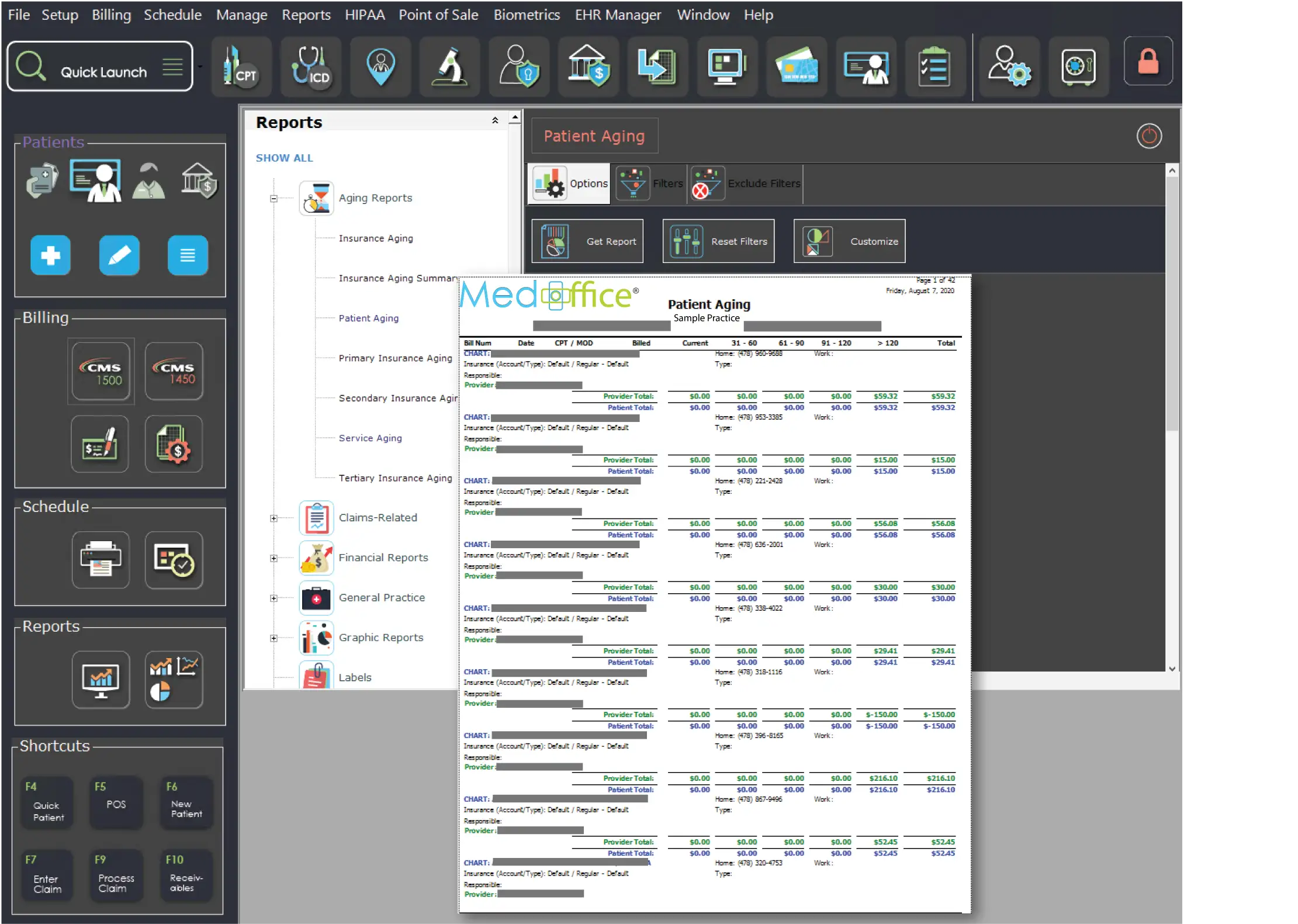
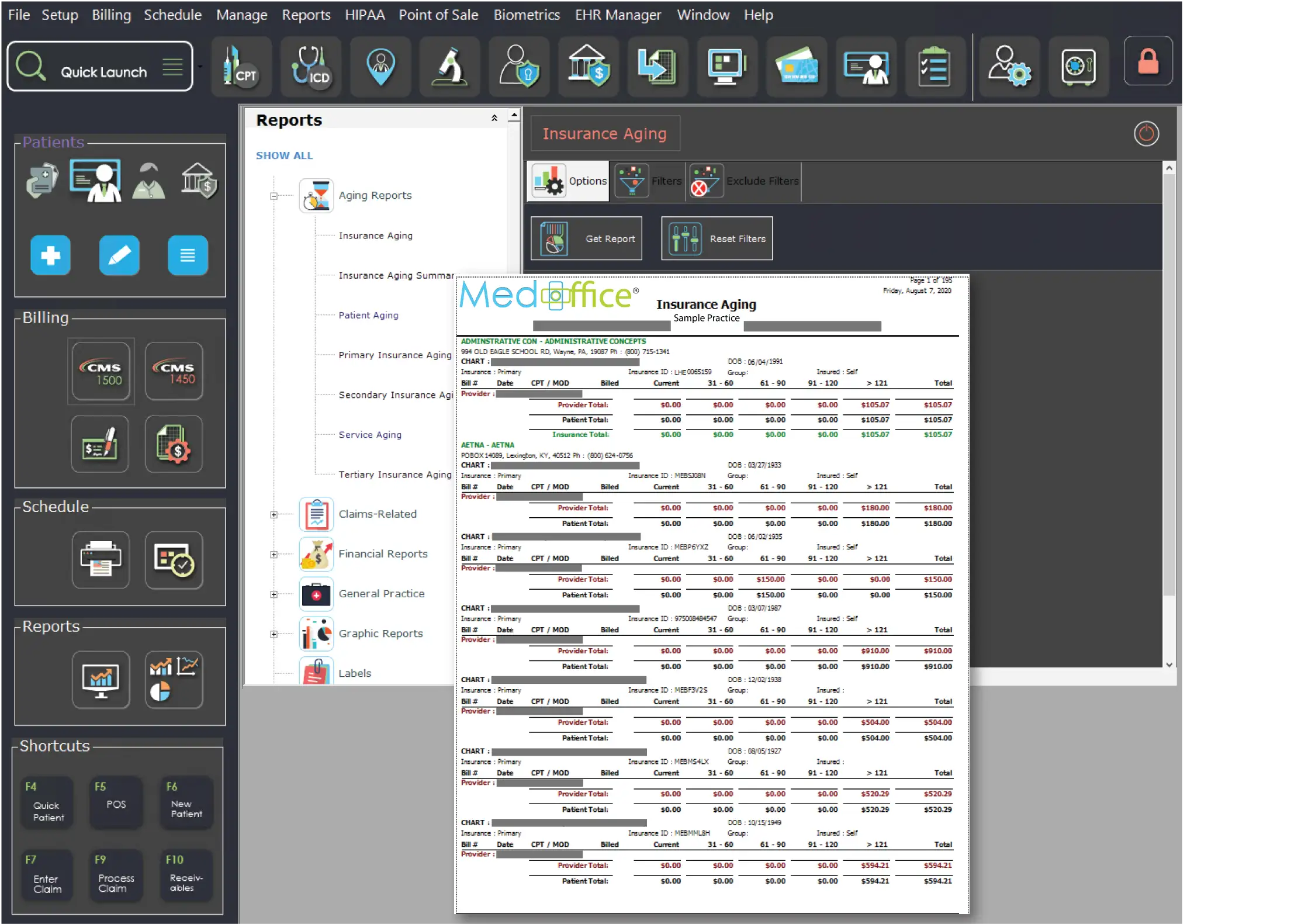
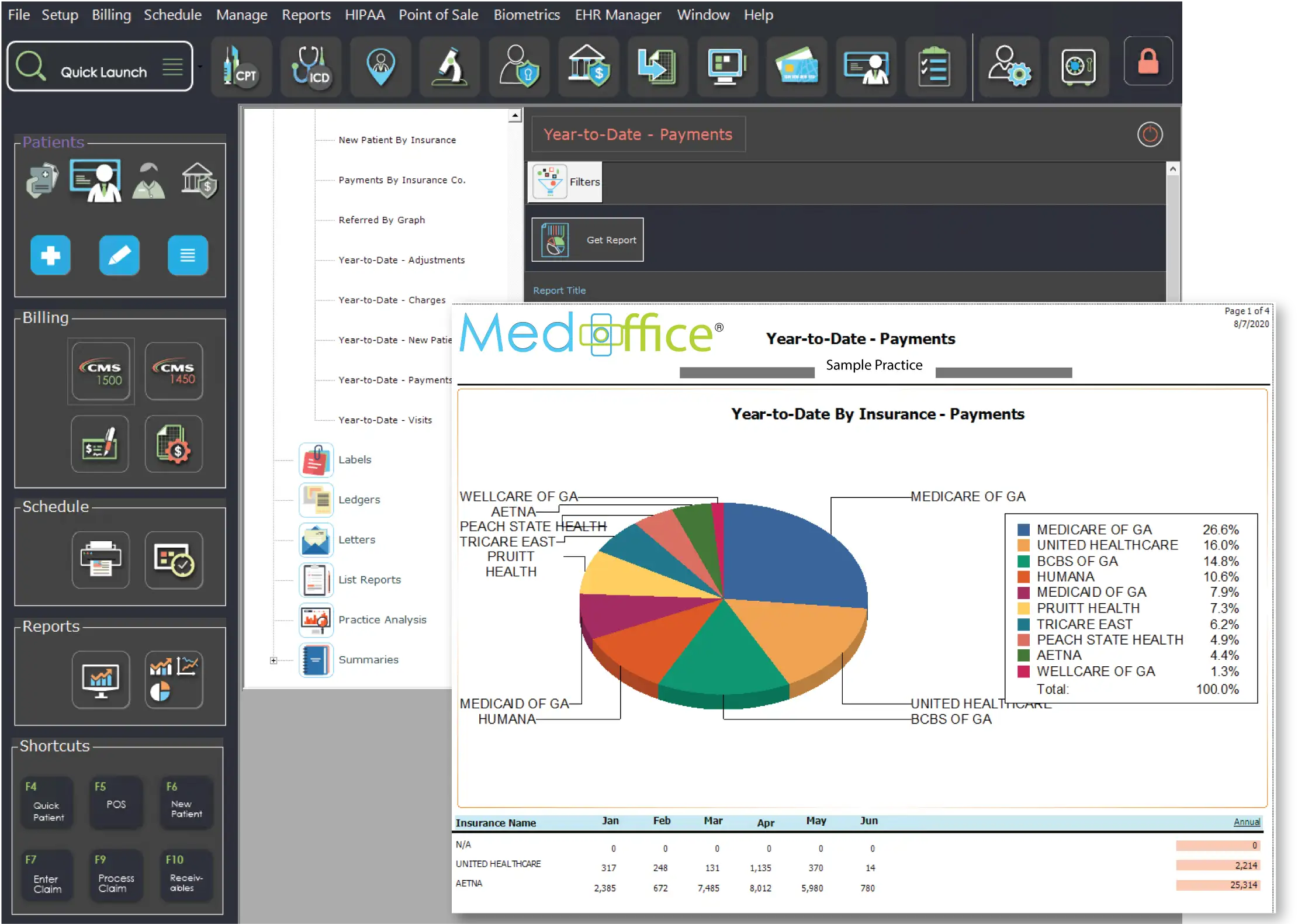
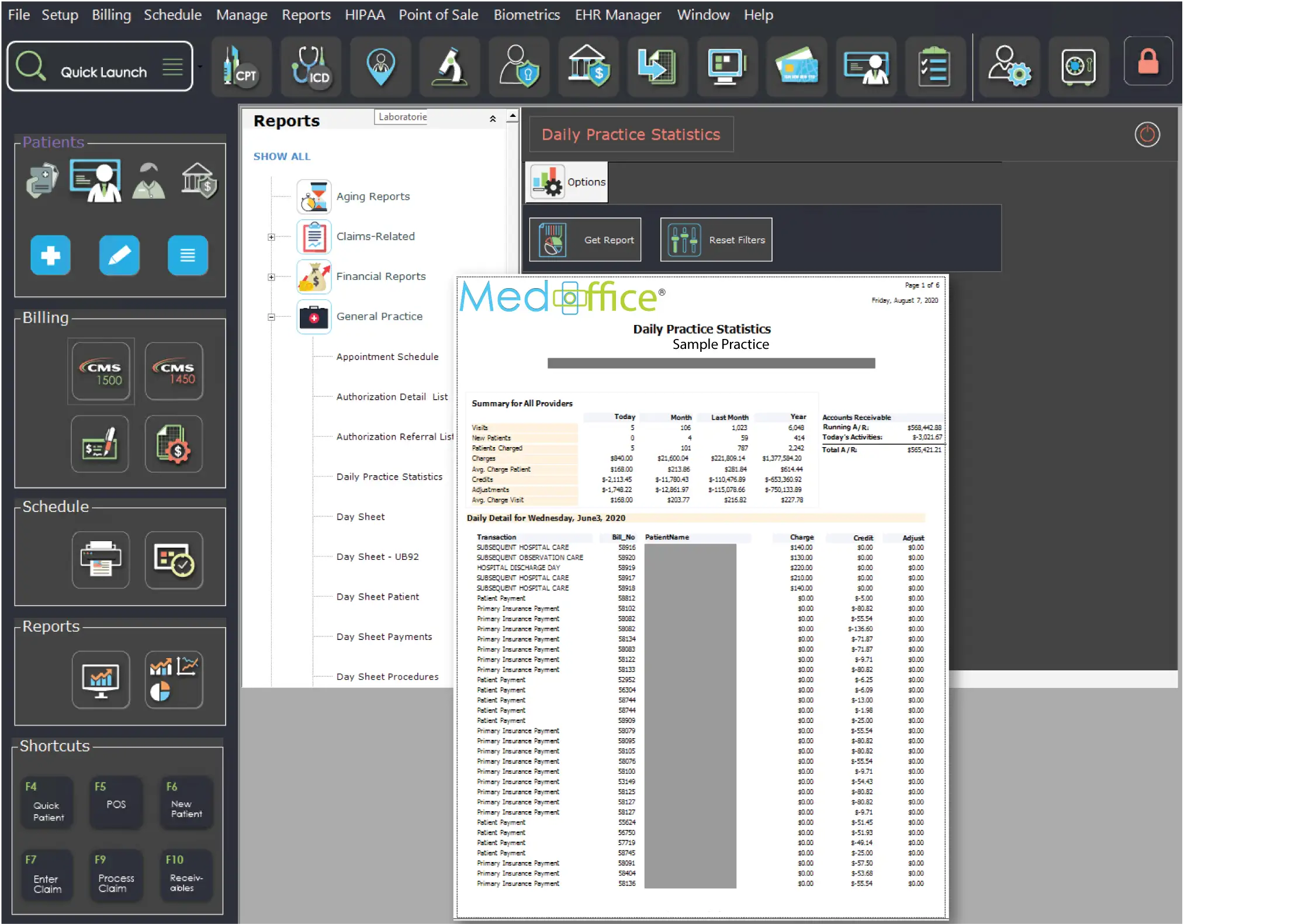
Monthly A/R aging, payer performance, denial reasons ranked by dollars, and production by provider. You get your own login and can pull any of it yourself, any time, without asking us.
What moves, what stays, and who you call.
The fear is not that outsourced billing doesn’t work. It’s that you lose sight of your own money. So here is exactly where the line sits.
- Stays with you: clinical documentation, coding decisions you want to own, the patient relationship, and final say on every write-off.
- Moves to us: charge entry, scrubbing, submission, follow-up, denials, appeals, posting, statements, and the payer phone calls.
- Shared: the practice management system. You keep your login and your data. Ownership of the database does not transfer to us at any point.
Visit and documentation
You see the patient and document it. Nothing about your clinical day changes.
Scrub and submit
Charges coded and checked against payer edits, then filed electronically. Rejections from the clearinghouse are fixed by us before they ever reach the payer.
Follow-up and denial work
Aged balances worked on a schedule. Denials appealed with documentation attached. You see every reason code in the monthly report.
Post, bill the patient, report
ERA posting, secondary claims, patient statements with online payment, then the month-end pack — A/R aging, payer performance, denial reasons by dollar value.
Most billing companies describe their reporting. Here it is.
Real outputs from the platform we run on — not marketing renders. You get your own login and can pull any of them yourself, at any hour, without asking us for a favour.

Paul D. — founder, and the person who answers.
The founder is on your account. Not a salesperson who introduces you to a team you then never speak to again — the person whose name is on the firm, with a direct line you can use.
His background is product management in technology, built inside regulated industries where handling sensitive data correctly was the job rather than a policy document. That shapes the first conversation: it is about how your practice actually runs — your payer mix, where the work piles up, what your front desk is already doing twice — before anyone proposes a solution. Most billing pitches run in the opposite order.
The rest — the ClaimTek certification behind the platform, what you can hold us to in writing, and what the first step costs — is on the About page rather than buried here.
The compliance answers, before you have to ask for them.
Usually this is the office manager’s list. It should not take three emails to get through it.
- BAA on request, signed before any PHI moves — not after onboarding starts.
- Encryption in transit and at rest, with role-based access so staff see only the practices they work.
- Redundant off-site backup on a schedule you set, plus on-demand.
- US-based work only. No offshore subcontracting of claims, coding or patient contact.
- Your data stays yours. You can export a full copy of your database at any time, and if we part ways you leave with it.
- This website collects no PHI. No patient details, no free-text message boxes, no uploads. The calculators run entirely in your browser and store nothing.
Nothing, and we’ll say what “nothing” means.
A/R audit
Send us an aging report and a superbill. We come back with where your money is sitting, which payers are slowest, and which denial reasons are repeating. It takes us about a week, and it takes you about ten minutes to send. You keep the report whether or not you hire us.
Practice analysis & code review
We price your current billing operation properly — labour and benefits, error handling, software and hardware, forms and postage, upgrades, the time value of the money you’re waiting on — and review your CPT, HCPCS or CDT codes for ones that are underpaying you. You get a figure for what in-house actually costs, which is usually not the figure people expect.
First credentialing free on a signed agreement
One payer credentialing application, at no charge, once you sign. If you are adding a provider this year that is real money and a fortnight of someone’s attention.
A percentage of collections — and we’ll beat your current rate
Not hourly, not a flat retainer, not per claim. We are paid a percentage of what we actually collect, above a threshold agreed in advance, so a claim we fail to collect costs us as well as you and rework sits on our side of the ledger.
Already with a billing company? Send us what you’re paying and what it covers. We will beat it on matched scope — or tell you plainly that we can’t and that you should stay put. We don’t publish a rate because a number without your specialty, volume and bundle behind it would be a guess, but we do publish exactly how the rate is set and what is never charged for at any rate. The pricing method and the rate challenge are here.
Things practices usually ask for second.
One line each. The detail is on the service pages.
Credentialing
One application from you; we run the payer maze and report progress until it closes.
Detail →Coding — CodeMAXX
Certified coders on your encounter notes, with current ICD, CPT, HCPCS and modifiers.
Detail →Statements & payments
Electronic statements, online bill pay, payment plans, autopay, funds direct to your account.
Detail →Collections
For the last few percent — patients pay you directly, and you decide the tone.
Detail →Audit protection — MD Audit Shield
Random self-audit of 50 records, corrections applied, and support if RAC arrives.
Detail →Well-care outreach
Recall letters, cards and emails for check-ups, testing and immunisations.
Detail →Transcription
ER, acute care, admission, surgical and discharge dictation returned in your format.
Detail →Document management & backup
Scan and retire the paper archive; off-site backup with encryption and validation.
Detail →HIPAA support
Forms, computer policy, disaster recovery plan and annual staff training.
Detail →Answered here so the call can be about your numbers.
What happens to my current biller?
If it’s a staff member, most practices move them to the front of house — eligibility checks, prior authorisation and patient balances, which is where an experienced person is worth most and where our involvement is smallest. If it’s another company, we run parallel for one cycle so nothing drops between systems, and we tell you plainly what to look for in their termination clause.
Do I have to change practice management software?
No. We can work in your system with our own logins, which is the least disruptive option and the one most practices take. If your system is the reason your denials are high, we’ll say so and quote the alternative — but that is a separate decision and we don’t bundle it into the billing agreement.
What does this actually cost?
A percentage of what we collect for you. We don’t publish a rate card, because a number without your figures behind it would be a guess — but we do publish the method, which is the part that actually protects you. Five variables set the rate: specialty, claim volume, average claim value, which services you bundle, and whether your state requires a fixed fee instead. Seven things are never charged for at any rate, including denial rework, appeals, data export and leaving. You get it in writing within five business days of the free A/R audit, with the workings shown.
And if you already have a biller: send us the rate and the scope, and we will beat it like for like — or tell you we can’t and that you should stay where you are. The pricing method and the rate challenge are here.
How fast does the switch happen?
Credentialing and payer enrolment set the pace, not us — some payers turn around in days, some take weeks. Charge entry can usually start inside the first week. We’ll give you a date-by-date plan before you sign anything, and the parallel-run period is in writing.
What if it doesn’t work out?
You give notice, we finish working the claims already in flight, and you leave with a full export of your data. No exit fee for the export, no hostage period on the database. Ask us for the termination clause before you sign — we’ll send it without you having to chase.
Why should I move my billing to a smaller firm?
Because the things that go wrong in billing are attention problems, and attention is exactly what a large firm cannot give you. You get the founder on your account, a fee tied to what we collect rather than what we process, and terms you can read before you sign. The people running this firm came from technology and product in regulated industries — building systems where sensitive data and audit trails were the job, not an afterthought.
And the first step is free and takes you ten minutes: send an aging report, get back a written analysis of where your money is sitting. You keep it either way.
Keeping billing in-house?
We also license and support the practice management software — MedOffice, DentOffice and EHR Manager — for practices that want to run it themselves.
Get a practice checkup, free.
Find out how much more you could be collecting. Fifteen minutes on a call, an aging report from you, and a written analysis from us — with the number attached.
- No obligation
- You keep the analysis
- No PHI needed to book